
When Is a Spool Really Finished?
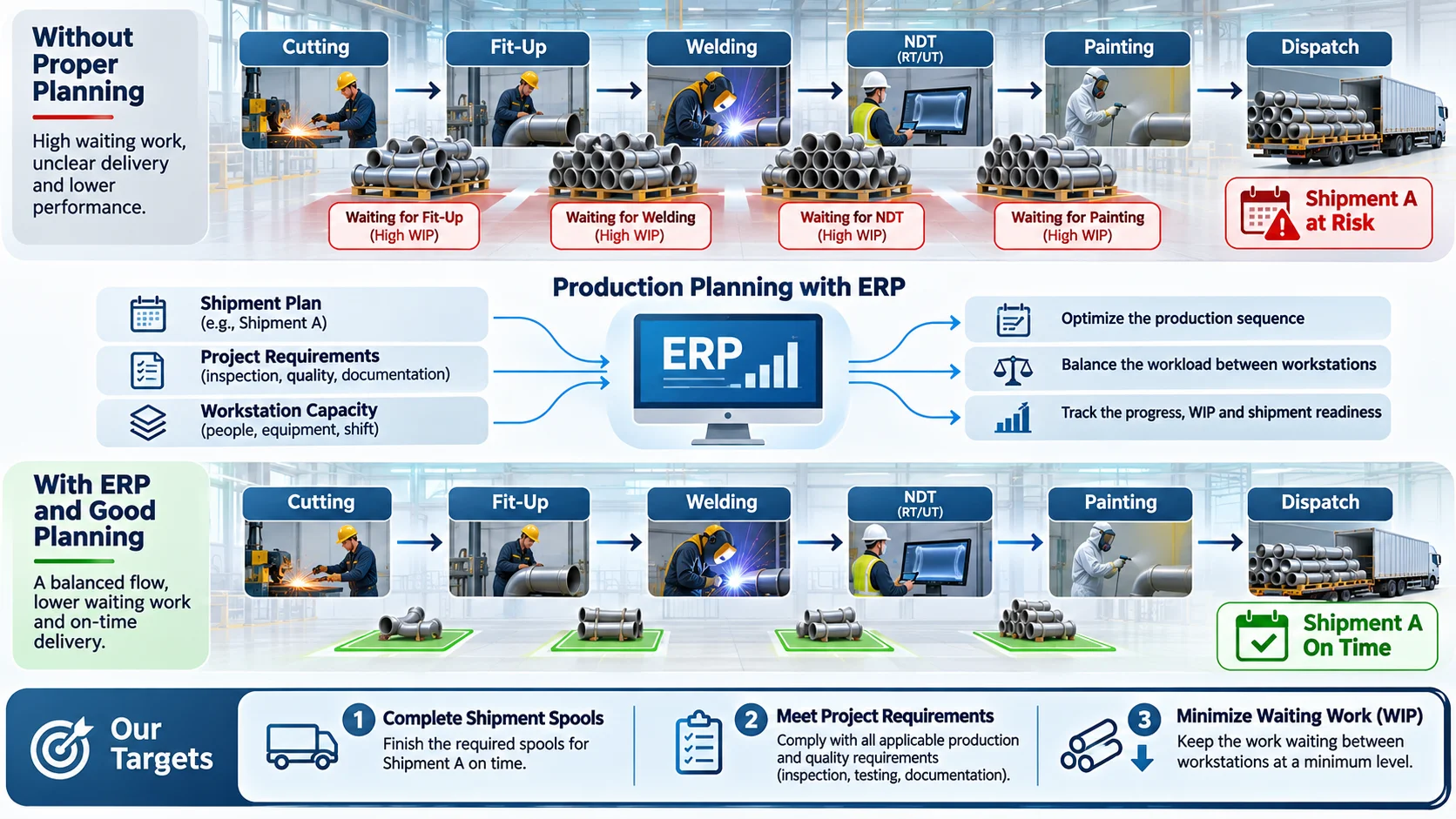
Why production flow, workstation capacity and shipment priorities matter in spool fabrication.
A Simple Question at the End of the Day
At the end of a working day, a pipe spool fabrication workshop prepares its production report.
The cutting team has completed its planned work. Fit-up and welding teams have also reported good progress. Several spools have passed quality inspections.
The production numbers look positive.
But the project coordinator asks two important questions:
“Have we completed the required spools for Shipment A?”
“Will the remaining spools be ready for dispatch on time?”
These questions may be more important than the total number of completed spools.
A workshop may finish many spools during the day, but some of them may belong to shipments planned for later dates.
Meanwhile, the spools needed for Shipment A may still be waiting for welding, inspection or painting.
This shows an important difference between completing production activities and meeting project delivery targets.
Production success is not only about how much work is completed. It is also about completing the right work at the right time.
Every Workstation Is Both a Customer and a Supplier
Spool fabrication is a connected production process.
Depending on the project, a spool may move through several stages:
Material Preparation → Cutting → Fit-Up → Welding → Inspection → Painting → Dispatch
Each stage receives work from a previous stage and prepares it for the next one.
For example, the fit-up station receives prepared materials and supplies assembled spools to welding.
The welding station receives these spools and supplies completed welding work to the next required operation.
Every workstation is a customer of the previous stage and a supplier to the next stage.
This relationship continues throughout the production process.
If one workstation produces more work than the next station can handle, products may start waiting between the two stages.
These waiting products become part of Work in Progress (WIP).
However, the aim is not to make every workstation produce the same number of spools.
Different operations need different amounts of time, equipment and skilled workers.
A complex spool may require many hours of welding, while a simple spool may need much less time.
Therefore, good production planning must consider the real workload and available capacity at each stage.
Why Production Flow Matters More Than Individual Output
Imagine a workshop where the cutting station can prepare material for 30 spools per day.
The fit-up station can assemble 20 spools, while the welding station can complete 12.
If cutting continues at its maximum capacity without considering the next stages, more material may wait before fit-up.
The same problem may happen between fit-up and welding.
Over time, this can create unnecessary WIP.
More products are waiting, but the number of spools ready for delivery may not increase at the same speed.
This does not mean that every workstation must have exactly the same capacity.
The important point is to plan the work according to the needs and limits of the whole production process.
Sometimes, a workstation may need to prepare work for a later operation. Sometimes, a small amount of waiting work may be necessary to keep production moving.
The goal is not zero WIP. The goal is to keep WIP at a useful level and avoid unnecessary waiting.
Good planning also needs to consider production priorities.
Completing a spool for next month’s shipment may be less urgent than completing a spool needed for tomorrow’s dispatch.
A workstation should therefore understand not only what it can produce, but also what the next stage needs and when the finished spool must be delivered.
Welding and NDT: A Practical Example
The relationship between welding and Non-Destructive Testing (NDT) provides a useful example.
In spool fabrication, different projects may have different inspection requirements.
One production line may require 100% Radiographic Testing (RT), while another may require only 10%.
Imagine two production lines.
Each line completes 100 welds.
Line A – 100% RT
All 100 welds require radiographic testing.
Line B – 10% RT
If the inspection percentage is based on the number of welds, 10 welds require radiographic testing.
Although both lines complete the same number of welds, the planned RT workloads are very different.
In practice, inspection requirements are defined by the applicable project specifications and quality plans.
A 10% RT requirement does not necessarily mean inspecting one in every ten spools. The percentage may apply to welds or another defined inspection basis.
Inspection time can also depend on weld size, material, inspection method and available resources.
Additional inspections may be required when defects are found.
This means the number of completed welds alone is not enough to calculate the real NDT workload.
What Happens When Inspection Capacity Is Lower?
Imagine that the welding stations complete work requiring 20 RT inspections per day.
However, the available RT team can complete only 12 of these inspections per day.
If this continues, eight inspections may be added to the waiting queue each day.
After five working days, 40 inspections may be waiting, assuming there was no waiting work at the start and no other changes.
The welding team may report good progress, but some spools cannot move forward because the required inspections are still waiting.
This can affect later activities and planned shipment dates.
However, the same welding output may create a much smaller RT workload on a production line requiring only 10% inspection.
Good planning must consider the inspection requirements, expected workload and available NDT capacity together.
The same principle applies to other workstation relationships.
Cutting and fit-up, fit-up and welding, inspection and painting all need to work as parts of one connected production process.
The welding–NDT example is only one way to understand this wider planning challenge.
When Is a Spool Really Complete?
A spool can be complete at one production stage but still have work waiting at another.
For example:
- Welding may be complete, but required inspection is still waiting.
- Inspection may have passed, but painting is not finished.
- Physical production may be complete, but quality documents are not approved.
- All required work may be complete, but the spool has not yet been prepared for dispatch.
Not every spool follows exactly the same process.
Some inspections may take place during fabrication. Some operations may happen in parallel. Repair work may also return a spool to an earlier stage.
This is why the word completed must have a clear meaning in production reports and ERP systems.
Imagine a project with 100 spools.
Welding has been completed on 80 spools, but only 45 have met all the requirements for dispatch.
The report may show:
| Production measure | Completion |
|---|---|
| Welding completed | 80% |
| Spools ready for dispatch | 45% |
Both numbers are correct, but they answer different questions.
The first shows welding progress.
The second shows dispatch readiness.
Neither number alone tells the project coordinator whether Shipment A will be ready on time.
For that, the coordinator needs to know which specific spools are required for Shipment A and what work remains on each one.
The Project Coordinator’s Real Question
Imagine that Shipment A requires 40 specific spools to be dispatched on Friday.
By Wednesday evening, 35 of these spools are ready.
The remaining five are at different stages:
- Two are waiting for welding.
- One is waiting for required NDT inspection.
- One is waiting for painting.
- One is waiting for final quality document approval.
The workshop may have completed another 20 spools during the day.
But if those 20 spools belong to Shipment B, they do not solve the immediate problem for Shipment A.
The project coordinator needs to understand whether the remaining five spools can complete their required work before Friday.
This requires more than a simple production completion percentage.
The coordinator needs information about the remaining operations, expected work hours, available resources and possible delays.
For example, the spool waiting for NDT may need only a short inspection, but the inspection team may already have a full schedule.
Another spool may require several hours of welding, but the welding station may have available capacity.
The important question is not only where a spool is waiting, but whether the remaining work can be completed before its required dispatch date.
This is where production planning, workstation capacity and shipment priorities must come together.
How Can ERP Support Better Planning?
ERP systems can connect production orders, material availability, operations, quality information and delivery schedules.
However, simply recording completed operations is not enough.
A useful ERP process should help planners understand the flow of work through the factory.
For example, it should help answer questions such as:
- Which spools belong to Shipment A?
- Which operations have been completed on these spools?
- What work is still required before dispatch?
- Which workstations have waiting jobs?
- What capacity is available for the remaining operations?
- Are there any missing materials, inspections or approvals?
- Can the required spools be completed before the planned shipment date?
This information can support better daily planning.
If the ERP system shows that several urgent spools are waiting for the same workstation, planners can review the work sequence and available resources.
If an NDT inspection is expected to delay an important shipment, the team can identify the risk before the planned dispatch date.
If a workstation has available capacity, the planning team can decide which work should be processed next based on project priorities.
This does not mean ERP can automatically solve every production problem.
Real workshop conditions may change during the day.
Equipment may become unavailable, materials may arrive late or additional inspection work may be required.
ERP information must therefore be connected with real production experience and regularly updated workshop data.
A good system helps people make better decisions. It does not replace their knowledge.
The Importance of Clear Production Status
For ERP information to support these decisions, production status must be clear.
A spool marked as Welding Completed should not automatically be treated as Ready for Dispatch.
A company may use statuses such as:
| Status | Meaning |
|---|---|
| Fabrication Completed | Planned fabrication activities are complete |
| Welding Completed | Required welding work is complete |
| Inspection Pending | Required inspection or approval is waiting |
| Quality Released | Required quality checks have been completed and approved |
| Ready for Dispatch | All dispatch requirements have been met |
| Dispatched | The spool has been sent |
These are examples. The correct workflow depends on the factory and project requirements.
Status information should also be linked to the operations and inspections that are actually required for each spool.
For example, a spool that does not require RT should not be forced to wait for an RT approval.
Similarly, a spool that requires RT should not be released before the necessary inspection and approval are complete.
This helps production teams avoid unnecessary waiting while maintaining the required quality controls.
Good Planning Is About the Whole Process
Production planning is not simply a question of keeping every workstation busy.
A cutting station working at full capacity may create unnecessary waiting work if fit-up cannot process the materials.
A welding station may complete many welds, but some spools may remain waiting for inspection.
A painting station may complete several spools, but the next shipment may still be missing other important items.
Every workstation has its own responsibilities, but all workstations contribute to the same delivery objectives.
Good planning connects the customer–supplier relationship between workstations with the final shipment requirements.
This means considering three important things together:
- Workstation capacity: How much work can each stage complete?
- Production flow: What work is waiting, and what does the next stage need?
- Shipment priorities: Which spools must be ready first, and by what date?
These three areas should support each other.
A good production plan does not simply move work from one station to another.
It helps the right spools move through the required operations at the right time.
Conclusion: The Right Spools at the Right Time
At the end of the day, each production team may report its completed work.
Cutting, fit-up, welding, inspection and painting may all show positive results.
But the project coordinator still needs an answer to the most important question:
“Will Shipment A be ready on time?”
To answer this, the company needs a clear view of the whole production process.
It needs to know which spools are complete, which are waiting, what work remains and whether the available capacity can support the planned delivery date.
The relationship between workstations is important because each station depends on the work of another.
The final shipment is important because it gives the production process a clear delivery target.
At ErsSoft Limited, we believe ERP systems should do more than record completed operations.
They should reflect real manufacturing processes, connect production activities with project priorities and help teams make better planning decisions.
A successful production plan is not measured only by how much work is completed, but by whether the right spools are ready for the right shipment at the right time.
Because, in the end, a spool is not really finished for the project until it has met all the requirements needed for its planned dispatch.
ERSSOFT Limited · ERP & JD Edwards Consulting
← Back to Insights