
Why Is Techno-Functional Expertise Important in JD Edwards EnterpriseOne Projects?
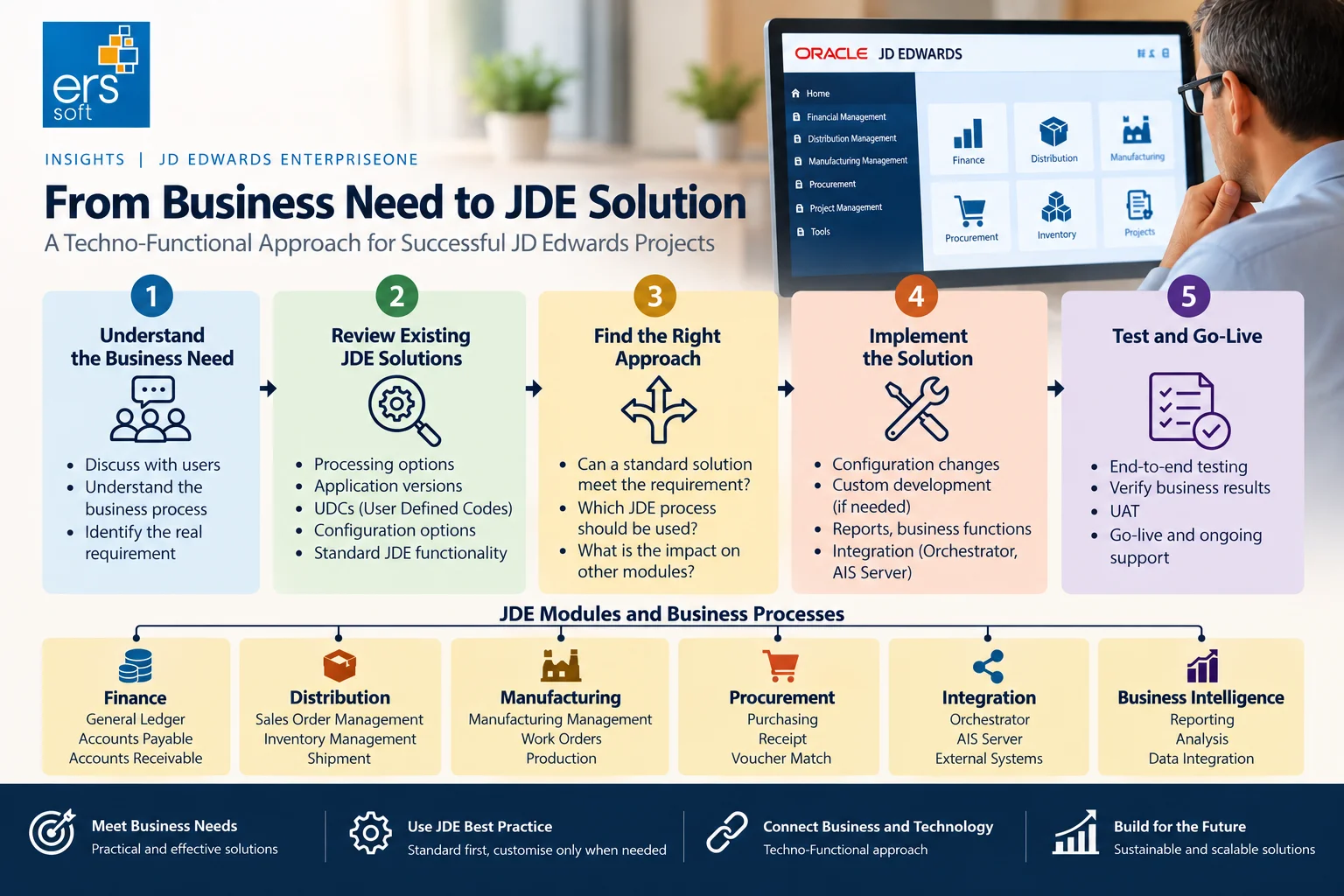
A successful JD Edwards EnterpriseOne project is not only about making the system work. It is also about understanding business processes and finding the right solutions within JD Edwards.
Different business areas, such as Finance, Distribution, and Manufacturing, work together in EnterpriseOne. A change in one area may affect another process or module.
For this reason, understanding both business processes and the technical structure of JD Edwards is a valuable advantage.
This is where the Techno-Functional approach helps connect business needs with technology.
From Business Requirements to JDE Solutions
A project usually starts with a business requirement.
For example, the Distribution team may need to process certain sales orders differently. The Finance team may also have specific requirements for the accounting entries created by these transactions.
The first step should not always be new development.
Before developing a new solution, it is important to review the existing processing options, application versions, UDCs (User Defined Codes), and configuration options in JD Edwards.
If standard JDE functionality can meet the requirement, unnecessary customisation can be avoided. This can make the system easier to maintain and upgrade in the future.
However, standard functionality may not always be enough. In these situations, custom applications, reports, business functions, or integrations can be considered.
The goal is not to create the most complex solution, but to find the most suitable one for the business.
A JDE Process Usually Involves More Than One Module
One of the important features of JD Edwards is the connection between its modules.
For example, a simple Sales Order Management process may involve customer information, inventory, pricing, shipment, and finally accounting entries.
Similarly, a Procurement process may start with Purchasing and continue through Receipt, Voucher Match, and Accounts Payable.
For this reason, when reviewing a requirement, it is important to look beyond the application or screen being changed.
The complete business process and its impact on other areas should also be considered.
This is where Techno-Functional knowledge becomes valuable.
Connecting Functional and Technical Teams
Functional and Technical teams usually have different responsibilities in JD Edwards projects.
A Functional Consultant focuses on business processes, configuration, and user requirements.
A Technical Consultant works on development, databases, interfaces, and other technical parts of the system.
However, in real projects, these two areas often work closely together.
For example, a new requirement may first need changes to an application version or processing options. If these changes are not enough, custom development may be required.
If the same process also needs to send information to another system, integration becomes part of the solution.
A Techno-Functional approach helps keep the original business requirement clear throughout the technical development process.
Integration: EnterpriseOne Is Part of a Larger System
Today, JD Edwards does not usually work alone.
Warehouse systems, banking applications, e-commerce platforms, reporting tools, and other business applications may exchange data with EnterpriseOne.
JD Edwards Orchestrator and AIS Server are important tools that can support these integrations.
However, a successful integration is not only about connecting two systems.
For example, when a sales order is received from an external system, several questions need to be considered:
- How will the customer be identified?
- How will item information be checked?
- How will branch/plant, order type, and business unit information be used?
- What should happen if an error occurs?
Understanding JDE business logic is just as important as understanding the technical integration.
Testing: Is It Enough That the Program Works?
A JDE solution may work correctly from a technical point of view but still produce an incorrect business result.
For example, a sales order may be created successfully. However, if the inventory movements or accounting entries are incorrect, the process is not complete.
This is why end-to-end testing is important.
During Unit Testing, Integration Testing, and User Acceptance Testing (UAT), it is necessary to check not only the changed application but also the related business processes.
This is especially important in connected areas such as Finance, Distribution, and Manufacturing.
After Go-Live: The System Continues to Develop
Go-live is an important milestone in a project, but EnterpriseOne does not remain unchanged after implementation.
New business requirements appear, processes change, and companies may need integrations with additional systems.
Existing applications may also need improvements.
For this reason, support should not only focus on fixing errors.
A good support process can also help improve the system, simplify business processes, and support long-term business needs.
Conclusion
The Techno-Functional approach helps connect business requirements with technical solutions in JD Edwards EnterpriseOne projects.
From standard JDE tools such as processing options and application versions to custom development and Orchestrator integrations, there are many possible solutions.
The important question is not which technology to use, but which solution best meets the business requirement and can be maintained in the future.
For a JD Edwards consultant, knowing how the system works is important. However, understanding why a business process is needed is equally valuable.
A good JD Edwards solution should not only meet today’s business needs but also be ready for future changes.
ERSSOFT Limited · ERP & JD Edwards Consulting
← Back to Insights