
Is Software Really the Problem in Your Company?
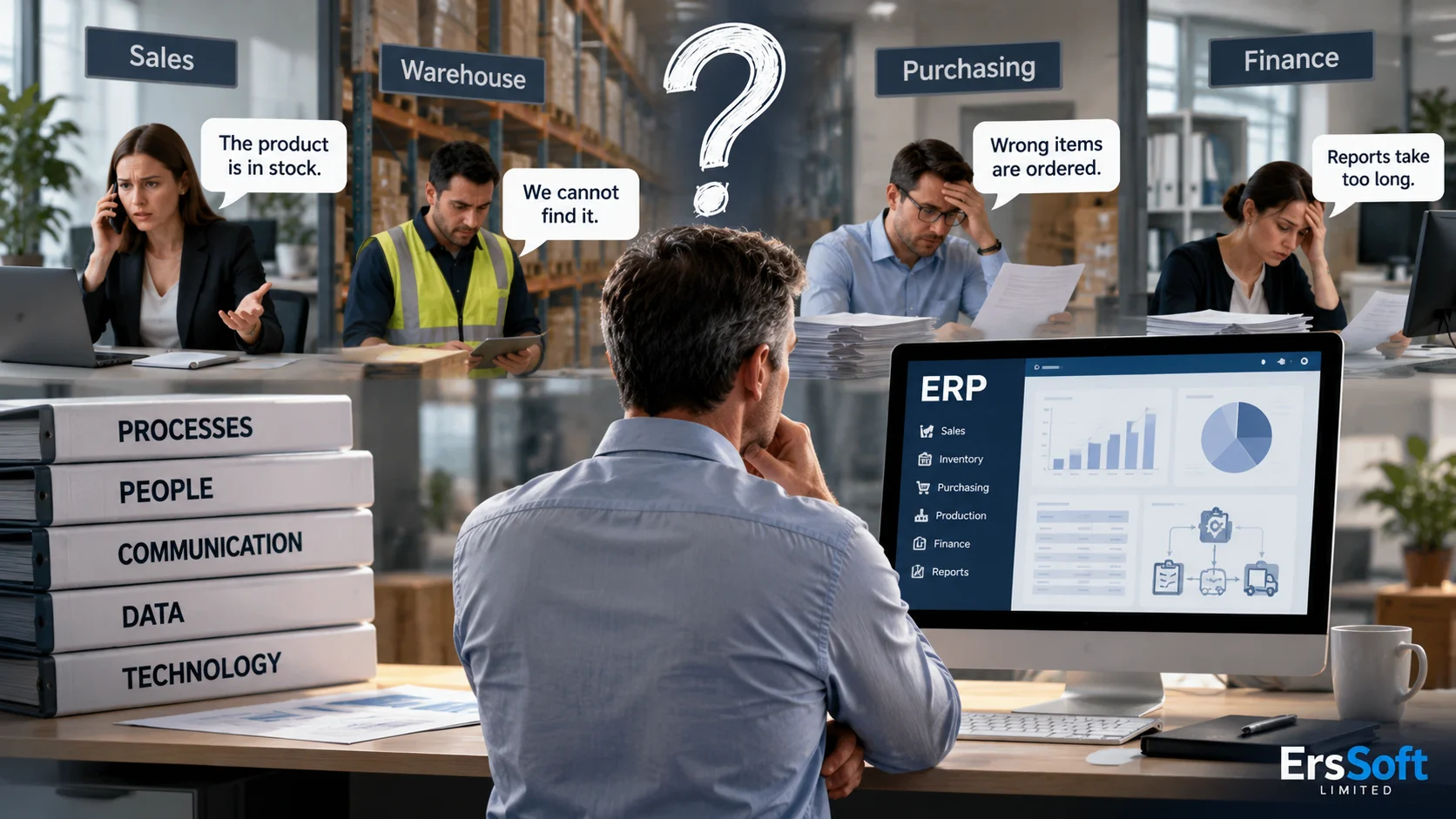
Imagine a company.
Sales are growing, new customers are coming, and the business is getting bigger. From the outside, everything looks fine.
But when you look at daily operations, you may see a different picture.
The sales team tells a customer that a product is in stock, but the warehouse cannot find it. The purchasing team orders materials that are not needed, while important items do not arrive on time. The finance team works long hours at the end of each month to complete its reports.
Managers ask for reports, but different departments provide different numbers.
These problems are common in many businesses.
So, is a new ERP system the solution?
Not always.
What Does an ERP Consultant Really Do?
When people think about ERP consulting, they often think about software installation, system configuration, and user training.
These are important parts of the job. However, an ERP consultant does much more than make a system work.
The first step is to understand how the company operates.
What happens when a customer places an order? How accurate is the stock information? How does the purchasing team make decisions? Are warehouse movements recorded on time? Why are financial reports delayed?
The answers to these questions are often more important than the software itself.
A company may have used the same working methods for many years. Employees may feel comfortable with these methods, but this does not always mean they are efficient.
An ERP consultant needs to understand the current processes, find the problems, and identify what should be improved.
Can ERP Solve Every Problem?
One common mistake in ERP projects is expecting a new system to solve every business problem.
However, moving a poor business process into a new system does not solve the problem.
For example, if stock movements are not recorded correctly, a new ERP system cannot automatically provide accurate stock information.
In the same way, if sales, purchasing, and warehouse teams do not share information properly, changing the software may not improve communication.
Business processes must first be clearly understood. The ERP system should then be configured to support these processes.
ERP is a tool. The real value comes from how a company uses it.
Common Mistakes in ERP Projects
ERP projects are not only about technology. People and business processes are just as important.
Here are some common mistakes.
Leaving the project only to the IT team
ERP affects many departments, including sales, purchasing, production, warehouse, and finance.
If these departments are not involved, important business needs may be missed.
Keeping old working habits
Some employees prefer to continue using Excel files or manual processes because they have worked this way for years.
It is important to understand their concerns and explain why changes are needed.
Too much customisation
Every business has its own requirements. However, not every request needs a new software development.
Too much customisation can make the system more difficult to maintain and upgrade.
Not spending enough time on testing and training
A system may work correctly from a technical point of view, but this does not mean the company is ready to use it.
Employees need time to test daily activities, understand the new processes, and learn how to use the system.
What Makes a Good ERP Consultant?
In my view, one of the most important qualities of a good ERP consultant is the ability to listen before offering a solution.
Instead of talking immediately about software modules, the consultant should first understand the company’s problems.
Sometimes, the solution does not require new software development.
A small change in an existing process or better use of a standard ERP function may be enough.
A good consultant should also be able to tell a customer, “You do not need this development.”
Technical knowledge is important, but communication is equally important.
An ERP consultant should understand business needs, work with different departments, and explain solutions in simple language.
The consultant should also consider what happens after the system goes live, including user support and future improvements.
The Role of Management in an ERP Project
A successful ERP project is not only the consultant’s responsibility.
Company management must also take an active role.
First, the business needs clear goals.
Do we want to improve stock accuracy? Reduce order processing time? Prepare financial reports faster? Or improve communication between departments?
Without clear goals, it is difficult to measure success.
Management should also make sure that the right employees have enough time to work on the project.
Important decisions should not be delayed, and employees should understand why changes are necessary.
An ERP project changes not only the system but also the way people work.
How Should ERP Success Be Measured?
An ERP project should not be considered successful simply because the system has gone live.
The real results should be visible in daily business operations.
For example:
- Has stock accuracy improved?
- Are customer orders processed and delivered faster?
- Can the finance team complete month-end closing more quickly?
- Have manual tasks and repeated data entry been reduced?
- Can managers access the reports they need on time?
By comparing these results before and after the project, a company can better understand the value of its ERP investment.
Final Thoughts
ERP consulting is not simply about installing new software or replacing an old system.
It is also about understanding how a business works, finding problems, and improving daily operations.
Sometimes, a company needs a completely new ERP system. In other cases, better use of the existing system can make a big difference.
Before starting an ERP project, the first question should not be:
“Which software should we use?”
It should be:
“What problem are we trying to solve?”
When a company understands the real problem, technology can provide real value.
ERSSOFT Limited · ERP & JD Edwards Consulting
← Back to Insights