
Does Your Company Really Need Another Software System?
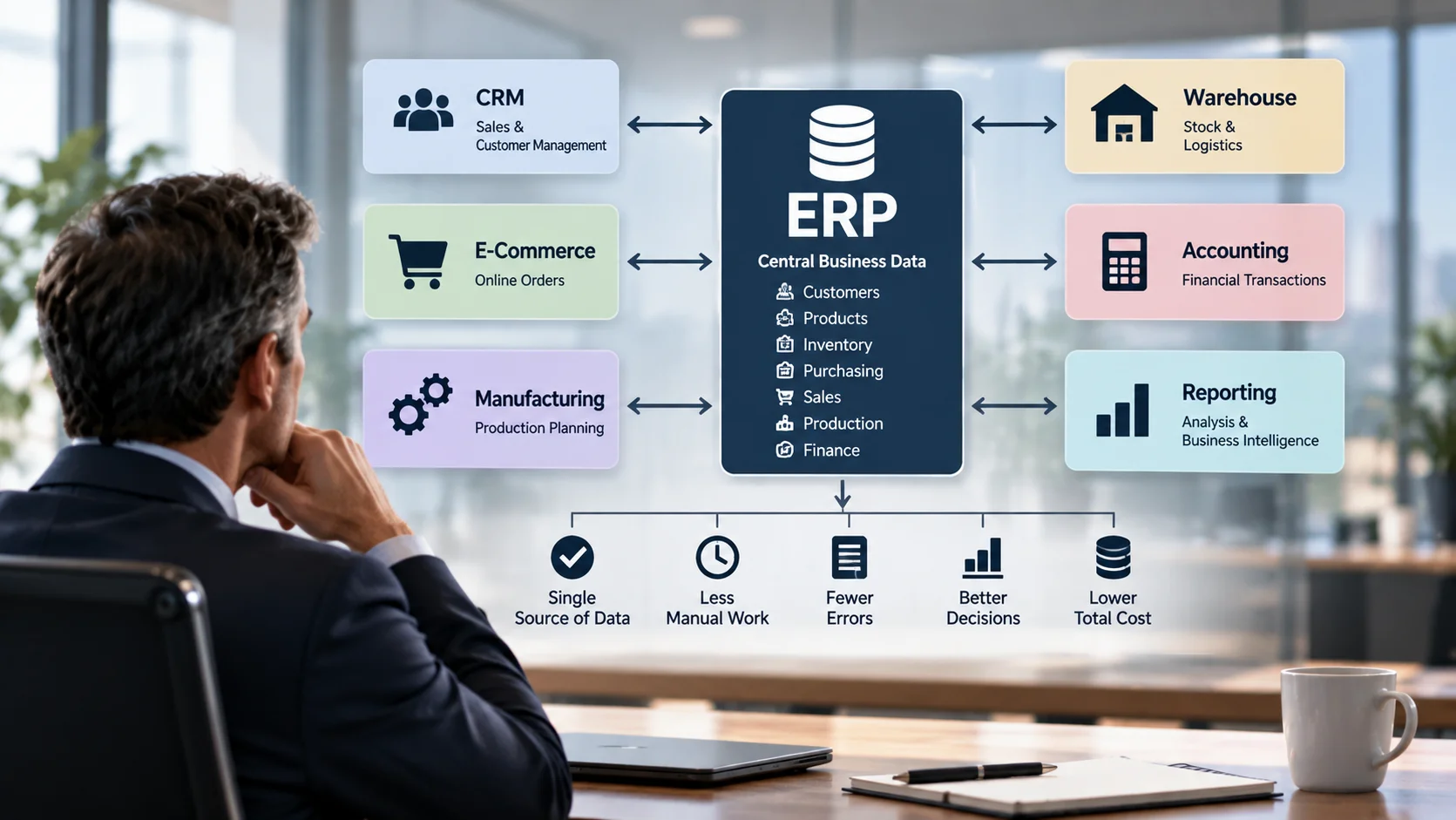
As a company grows, different departments may ask for new software.
The sales team wants a CRM system. The warehouse wants a separate warehouse management application. The production team needs a planning tool, and management wants better reporting software.
Each request may have a good reason.
However, before buying another application, company management should ask an important question:
“Why can’t we do this in our existing ERP system?”
ERP Should Be at the Centre of the Business
In my view, ERP should be the main system for a company’s core business information.
Customers, suppliers, products, stock, purchasing, sales, production and financial transactions should be managed through a central business structure.
Other applications can support the ERP system when they provide functions that the ERP cannot offer effectively.
But these applications should not create separate and conflicting versions of business information.
The goal should be to have one reliable source of information for important business decisions.
This does not mean that every document or every type of data must physically be stored in the ERP database. It means that responsibility for important business information should be clearly defined.
Why Do Companies Buy Additional Software?
Sometimes, a department finds a new application that looks easier, faster or more modern than the existing ERP system.
The software may have an attractive interface and useful features.
But this does not automatically mean that the company needs it.
Before making a decision, management should understand three things:
- What can this application do that our ERP cannot do effectively?
- Should this missing function be part of our ERP system instead?
- Will this additional function create enough business value to justify its cost?
These questions should be answered before discussing system integration.
Use a Decision Matrix Before Buying
Software decisions should not depend only on personal preferences or product demonstrations.
A simple evaluation matrix can help management compare business value, cost and operational risks.
Each proposed application can be scored from 1 to 5 against agreed criteria.
| Evaluation criteria | What management should consider |
|---|---|
| Business need | Does the application solve a real business problem? |
| ERP capability | Can the existing ERP already provide the required function? |
| ERP improvement | Would improving the ERP be a better long-term solution? |
| Business benefit | Will the application save time, reduce costs or increase revenue? |
| Total cost | What are the licence, implementation, support and integration costs? |
| Data management | Will it create duplicate or conflicting information? |
| Operational risk | Will it increase system complexity or business dependency? |
Not all criteria are equally important. Management can give higher weight to business value, total cost and data reliability.
The matrix supports the decision, but it should not replace management judgement.
Every Additional System Has a Cost
The purchase price is only one part of the total cost.
An additional application may require:
- Software licences and subscriptions
- Implementation and configuration
- Integration with ERP
- Employee training
- Maintenance and technical support
- Security management and future upgrades
There may also be hidden costs.
Employees may need to check information in two systems. Integration errors may require manual corrections. Different departments may become dependent on different software providers.
Over several years, these costs can become significant.
Compare the Cost with the Business Benefit
Imagine that a company wants to buy a separate warehouse application.
The new application costs £15,000 per year, including licences, support and integration.
Management estimates that it could save £25,000 per year through reduced manual work, fewer picking errors and faster warehouse operations.
If these estimates are realistic, the investment may make business sense.
However, management should also check whether the existing ERP can provide similar improvements at a lower cost.
If an ERP improvement costs £5,000 and delivers nearly the same benefits, buying another system may not be the best decision.
The important question is not which software has more features.
It is which solution creates the greatest business value at a reasonable total cost.
When Is Integration the Right Choice?
There are situations where a specialist application offers functions that an ERP system cannot provide effectively.
For example, a specialist production planning system may support complex scheduling requirements that are difficult to manage within the standard ERP.
In this situation, using an additional application may be justified.
But the company should clearly define which system controls each type of information.
The ERP may remain responsible for products, inventory, orders and financial transactions, while the specialist application manages its specific planning functions.
Integration should then support this agreed business structure.
It should not be used simply to connect applications that were purchased without a clear plan.
The Role of Management
A new software request should not be approved only because one department wants it.
Management needs to consider the whole company.
An application may make one department’s work easier but create additional costs or problems for other departments.
The decision should involve business managers, ERP specialists, IT and finance.
Together, they should review the decision matrix, compare alternatives and estimate the expected return on investment.
After implementation, the company should measure whether the expected benefits have actually been achieved.
Final Thoughts
Adding more software does not always make a company more efficient.
Sometimes, it creates more costs, more integration work and more complicated business processes.
ERP should remain the centre of core business information, while additional applications should have a clear and justified purpose.
Before buying another system, management should ask:
“What business value will this software add that our ERP cannot already provide?”
If the answer is clear, measurable and financially justified, an additional application may be the right choice.
If not, improving the existing ERP system may be the better investment.
ERSSOFT Limited · ERP & JD Edwards Consulting
← Back to Insights